

Green building certification is reshaping New Zealand’s construction sector, redefining the role roofing plays in modern buildings. With further changes to Green Star certification applying to projects registered from 1 May 2026, the focus on embodied carbon, operational energy use, and long-term building outcomes continues to intensify.
The updated standards will tighten minimum embodied carbon reduction targets. For example, projects seeking a 4 Star rating will need to achieve a reduction of around 15% compared with baseline levels, up from current requirements. Stricter operational energy targets will also apply, alongside expanded requirements relating to refrigerant emissions and the management of peak electricity demand.
According to the New Zealand Green Building Council’s Green Star Buildings Carbon Reduction Strategy, these staged changes are designed to help align the built environment with national climate goals and a finite global carbon budget. As expectations around building performance continue to evolve, greater emphasis is being placed on how each part of the building contributes to long-term outcomes.
From building layer to performance system
While sustainability discussions often focus on structure and services, the roof is one of the most exposed and influential parts of the building envelope. It plays a direct role in regulating heat gain, heat loss, and internal environmental stability.
As a result, roofing systems influence both embodied carbon, through materials such as steel, insulation, and membranes, and operational energy use through their impact on thermal efficiency and durability. Roof design also plays an increasingly important role in enabling renewable technologies such as solar installations, plant equipment, and water management systems now commonly integrated into roof design.
For contractors, this represents a shift away from roofing as a standalone trade toward a more integrated role within the overall building system. Roofing is no longer simply about weatherproofing. It is about contributing to how a building performs over its entire lifecycle.
Topline Roofing Director Neil Gillespie explains, the expectations placed on roofing have shifted significantly, with the roof “no longer just a building layer – it is a performance system that directly influences sustainability outcomes.”
Case study: Te Aukati, Auckland
This shift is clearly demonstrated in high-performance projects such as Te Aukati in Auckland, a 6 Star Green Star rated commercial building delivered by developer and main contractor Mansons TCLM Ltd.
RANZ member Topline Roofing was responsible for delivering the roofing scope, which included a post-and-rail warm roof system across the entire roof area, along with integrated safety systems and provisions for solar infrastructure.
The roofing system played a critical role in supporting the building’s overall performance outcomes. As the primary interface between the building and the external environment, the roof was central to managing thermal performance, moisture control, and internal environmental stability.
The rooftop also incorporates solar panels and rainwater harvesting systems, demonstrating how roof design can support both energy efficiency and resource management.
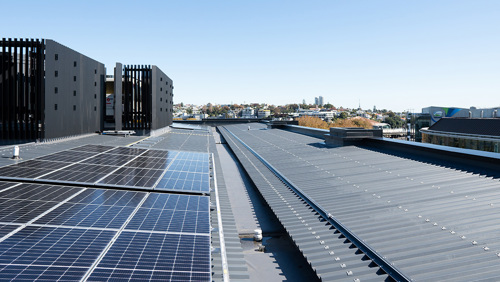
Te Aukati's roof incorporates a post-and-rail warm roof system installed across approximately 2,430m², using 0.55g Magnaflow MSR Topdeck. For more of their work visit www.toplineroofing.co.nz
Photos courtesy of: Topline Roofing & Society Marketing Ltd.
Delivering to a higher standard
Delivering a project at this level required a significantly higher level of coordination and installation discipline than a typical roofing project.
The warm roof system had to be installed in strict accordance with manufacturer specifications, with no tolerance for deviation in sequencing or detailing. Achieving the required performance outcomes relied on maintaining a continuous, airtight, and well-executed roof assembly.
As Gillespie notes, “at this level of specification, precision isn’t optional – it defines whether the building performs as designed.”
This reflects a broader shift across the industry. As buildings become more performance-driven, the margin for error reduces, and installation quality, sequencing, and system integration become critical to success.
The project also highlighted the increasing importance of coordination between trades. Roofing systems must integrate seamlessly with structural elements, mechanical systems, and façade components to achieve the required performance outcomes.
Complexity on site
The Te Aukati project also presented logistical challenges. Located within Auckland’s CBD, materials needed to be carefully scheduled and craned into position several storeys above ground, requiring detailed planning of lifting operations, sequencing, and site coordination.
Maintaining safety, programme efficiency, and installation accuracy under these conditions was essential. In high-performance projects, there is little tolerance for rework, as even minor deviations can compromise system integrity and overall building performance.
This level of complexity is becoming more common as commercial projects increase in scale, density, and performance requirements.
A shift in expectations across the sector
Projects like Te Aukati reflect a broader change across the commercial construction sector, with a clear shift toward higher-performance buildings and a greater focus on whole-of-life outcomes.
As these expectations evolve, roofing contractors are also seeing changes in how projects are delivered. Greater emphasis is being placed on coordination with designers and other trades, as well as ensuring systems are installed exactly as specified. There is also increasing focus on how roofing materials and systems contribute to overall building performance, particularly in relation to durability, energy efficiency, and long-term outcomes. While these considerations are often driven at a design level, they are increasingly influencing on-site practices and expectations around quality, sequencing, and compliance.
Topline Roofing is seeing increasing demand for roofing systems that support energy efficiency, durability, and future adaptability. As Gillespie explains, there is now “greater emphasis on whole-of-life building performance rather than upfront capital cost alone.”
This shift is influencing both design and specification decisions. Warm roof systems are becoming more common due to their ability to improve thermal performance and create more stable internal environments. While they often involve a higher upfront cost, the operational benefits are increasingly understood and valued.
At the same time, expectations around roofing are expanding beyond thermal performance alone. Solar integration is now a key consideration on many projects, with roof layouts, structural provisions, and access requirements being designed accordingly from the outset.
Beyond sustainability: performance, comfort and value
The conversation around sustainability is expanding beyond carbon alone. Increasingly, commercial buildings are expected to support occupant wellbeing, with greater emphasis on indoor air quality, thermal comfort, and acoustic performance. Roofing systems contribute to these outcomes through their influence on temperature stability and overall building envelope performance.
Gillespie notes, this reflects a broader shift toward buildings that support “occupant health, wellbeing and overall environmental performance.”
Higher-performance buildings are also influencing market expectations. Premium tenants are seeking workplaces that deliver comfort and quality, while building owners and insurers are placing greater importance on durability, risk reduction, and long-term asset performance.
This is reinforcing the role of roofing as a key contributor not only to building performance, but also to long-term value.
Looking ahead
While not every project will pursue Green Star certification, these standards are influencing broader market expectations across commercial and public sector construction.
Many of the principles involved, including robust weather protection, effective insulation, and long-lasting materials, already align closely with established best practice within the roofing industry. What is changing is the level of integration, precision, and accountability required to deliver those outcomes.
Looking ahead, roofing is expected to continue evolving as part of a more integrated building envelope approach, where systems are designed to work together to achieve multiple performance outcomes.
As Gillespie puts it, roofing will continue to evolve “from a protective layer into a key performance driver within high-performance building design.”
As sustainability targets continue to develop, roofing professionals will remain central to delivering practical, durable solutions that support improved building performance now and into the future.
This article was originally published in the Winter 2026 issue of RoofLink magazine.


